

My Mission
Unleashing canine superpowers
We’ve long known that dogs have amazing noses. They can sniff out bombs and drugs. 20 years ago a report in a British medical journal showed that dogs can detect bladder cancer from urine.
What if we could unleash a dog’s super power to diagnose cancer and other diseases early, when curing them is much easier?
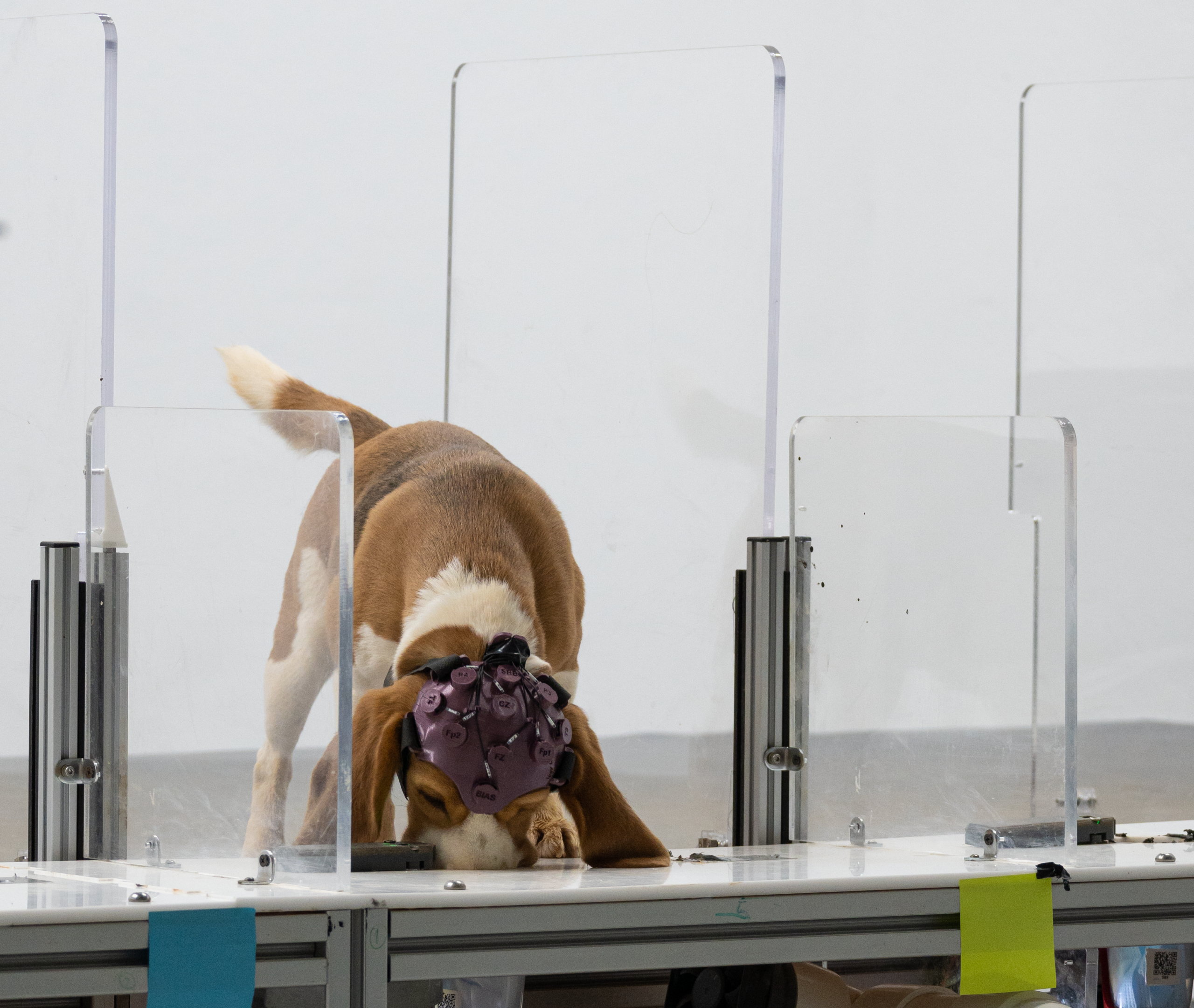
That’s what we’re aiming to do at Dognosis. We’re a 50 individuals inter-species pack (36 humans, 14 dogs) working on a way to detect cancer that’s more reliable and cheaper than existing diagnostics. Here’s how it works: our dogs sniff breath captured in face masks. When they detect cancer, they signal us by running to a treat station. We track their brain waves and body langauge with a helmet they wear and sensors on the platform, to translate their “thoughts” into signals that AI/machine learning tools can interpret. That’s important, because we want this approach to scale without needing lots of humans trained to understand dog body language.
Our dogs already are more sensitive than most blood-based tests. Breathing into a mask is also less painful and cheaper than getting your blood drawn. Our goal is to make early screening so cheap that it’s accessible to everyone—and more expensive tools like colonoscopies and mammograms can be reserved for following up when the dog sniff test comes back positive.
My Path
From a family of doctors in an Indian town to start-up founder
I grew up in a small city in India. Both my parents are doctors, as are 9 other close relatives. So medicine is in my blood—but I wasn’t interested in doing direct patient care: I saw how working directly with patients, you’re limited in how many people you can help even if you work long 12-hour days.
I was fortunate to be able to study at UC Berkeley, and got excited about cognitive science. When COVID happened, my dad had the tough job of triaging patients. At the same time, I read a press article about how dogs could smell COVID—and I got intrigued: what if we could use cognitive science to scale disease sniffing, so it could go from isolated studies and cute photos to a real, practical tool?
After graduating, I went back to India. I applied for and received an Emergent Ventures India grant, which I used to fund myself to be a visiting researcher at a bunch of labs around the world. I learned that doing this type of work isn’t mysterious. Then I met my co-founder—a product person who honed his dog skills working in an elite Israeli K9 unit and later at a groundbreaking disease detection dog start-up in Israel.
2 1/2 years later, we have raised $1.6M and run clinical trials at eight hospitals, assessing 6,500 samples. The trust by early believers and backers gave me the confidence that as a person in my 20s I can unleash dogs’ superpower to better human lives.