

My Mission
Turning chaos into life-saving care, fast
When something scary happens—a car crash, a bad asthma attack, a stroke—you don’t get days or even hours to figure it out. You have minutes. My emergency room is where people in Denver walk in (or roll in by ambulance), 24/7. My job is to keep you alive, relieve pain, and figure out what is wrong, quickly.
It’s being a doctor in a chaotic, uncertain environment. We meet patients we’ve never seen before, with little history, patients who are scared—for many it’s the worst day of their lives. That means rapid triage (figuring out who needs help first), fast detective work (is this a heart attack, a drug overdose, anaphylactic shock from an allergy?), and working closely with a team of paramedics, nurses, technicians, and other specialists like trauma surgeons and cardiologists. We take pride and satisfaction when performing rapid life saving procedures, like evacuating a dangerous amount of blood and air from someone’s chest after a car crash—but great days are also the ones where no one comes in with a life threatening illness, and when we can focus on delivering warm and compassionate care.
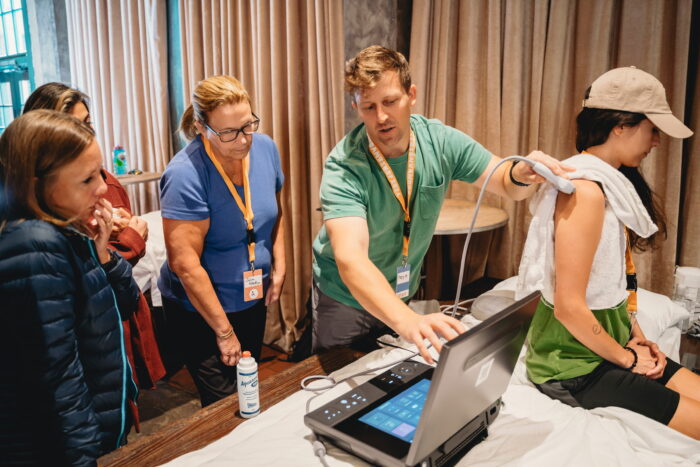
Since I work at a university-affiliated hospital, I am also a teacher: I supervise aspiring and new doctors, and I teach them hands-on skills outside the ER. For example, I teach them how to best use bedside ultrasound—a powerful tool that has gotten smaller and is now enabling us to see inside the body right at a patient’s bedside, without needing to transport them to a diagnostic room. It helps us diagnose pregnancies and spot ruptures of the aorta (the main blood vessel to the heart) which require emergency treatment. We sometimes even place an ultrasound probe inside the esophagus or use ultrasound to deliver medicine to the right nerve and relieve someone’s pain. It’s exciting that new doctors can now have x-ray vision to see what’s going on inside someone’s body, immediately, right at the bedside, so they can make better decisions when minutes matter.

My Path
Witnessing care in chaos inspired a career change
Being an ER doctor is my second career. I didn’t study pre-med or science as an undergrad. My bachelor’s is in English (non-fiction writing specifically), and I spent time working as a journalist. Then, in April 2013, I witnessed a tragic event—the horrific terrorist bombing at the Boston Marathon, which killed three people and injured more than 260.
I saw how emergency responders—paramedics, ER doctors and surgeons at trauma centers—saved lives. But for Boston’s outstanding handling of this mass-trauma event, many more might have died. Witnessing that teamwork under pressure inspired me to enroll in medical school.
Today, my goal is to inspire others through the use of bedside ultrasound and continuing to use writing to share the realities of our day-to-day experiences in the ER.