

My Mission
Germ-free indoor air, as commonplace as safe drinking water
Over 150 years ago, people believed disease was caused by miasma—bad air that could make us sick. Based on that belief, many public health efforts around that time were focused on ventilation and clean air. When scientists discovered bacteria and determined that these same germs caused disease, public health officials shifted their attention to improve the quality of sanitation and water in particular. This pivot meant interest in strategies to prevent airborne disease transmission would take a backseat to other sanitary innovations, such as clean water.
With the emergence of the COVID-19 pandemic this sentiment changed. Suddenly researchers, scientists, and policymakers were scrambling to identify solutions to curb the spread of an airborne pathogen while trying to subdue the fears of society at large. While many people learned to adapt and evolve to the changing times, many were faced with the grim reality and cost of what it meant to be unprepared for a global health crisis. To this day, we’re still recovering from the losses from the COVID-19 pandemic – a preventable event that resulted in an estimated 15-25 million excess deaths worldwide.
Still today society is grappling with how to prepare and respond to the next pandemic. While there has been significant investment in pharmaceutical countermeasures (like vaccines) to prevent the spread of disease, other non-pharmaceutical interventions have received less attention and interest.
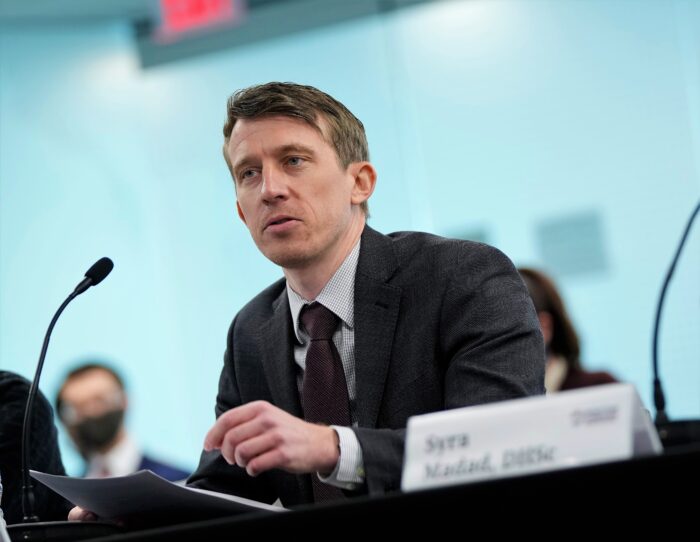
This is where Blueprint Biosecurity comes in. We’re developing strategic roadmaps and funding targeted research to accelerate practical technological solutions that can suppress airborne pathogen transmission and ultimately prevent the next pandemic. Our work covers three main areas: far-UVC, a germicidal light that can kill viruses and bacteria in the air and on surfaces; personal protective equipment, understanding what barriers exist to providing critical workers with reusable respirators; and glycol vapors, an abundant additive in consumer goods that could be an effective and safe tool for air disinfection.
My Path
Applying astronomical ambitions to cleaning up the air we breathe
Growing up I wanted to be an astrophysicist. I was excited about space, the stars, and how the universe works. That interest led me to pursue an undergraduate degree in physics and eventually a career at Lockheed Martin, one of the largest aerospace companies in the world. While at Lockheed Martin, I started working in the field of nanotechnology—the engineering of materials at the scale of atoms and molecules. At some point, I worked on applying nanotech to a water desalination membrane and learned an important lesson: the technical solution worked—but it was 100x too expensive to be practical. I also discovered that water problems were often complex law and public policy issues, which were fascinating to me. My love of research and desire to understand how things worked at that scale led me to pursue a PhD. I quickly realized that academia wasn’t for me. My PhD gave me new tools, but I was searching for a bigger problem to apply them to. Academia lacked the incentives and opportunities to apply technology to solve big, real-world problems, and many problems were bigger than a single lab could address, both of which deterred me from staying.
When the COVID-19 pandemic struck, I felt inspired to use my expertise to help a huge practical problem: how do we prevent the next pandemic? I was given the opportunity to lead the Bipartisan Commission on Biodefense’s Apollo Program for Biodefense, which laid out a roadmap for using technologies like Far-UVC to keep people safe from COVID-19. When little progress was made to implement the report’s ideas, I decided to start Blueprint Biosecurity to bring these ideas to life.
Just as space exploration requires ambitious engineering and collaborative problem-solving, preventing the next pandemic demands the same approach. By advancing research into non-pharmaceutical countermeasures and bringing together funders, policymakers, builders, and researchers, we can apply the ambition that took us to the stars to eliminate the toll of airborne diseases here on Earth. The sanitary revolution was a foundation for health and wealth – it’s time we finish it by making the air we breathe as clean as the water we drink.